Published by CivilEngineers.com, a Family Office Club project. Built from the published practitioner and industry sources listed below. General education only. How we source.
About the data
Qualitative process framework written for this asset. No quantitative external data is used. The graphic is a discussion aid, not a recommendation of any path. Which documents and tax rules apply depends on the firm.
Use note
These are broad categories, not recommendations. Actual rights depend on entity structure and governing documents. A business attorney, a CPA and an M&A adviser can review any proposed arrangement. Terms such as ESOP have specific legal and tax requirements.
Employee ownership: ask about financing and allocation
A principal and chief architectural officer described seller financing as part of an ESOP transition. Separately, a firm president and CEO described an ESOP allocation based on a percentage of pay, so employees did not receive identical dollar amounts. These are examples of particular arrangements.
Questions for ESOP counsel and a qualified CPA: How would the proposed transition be financed? Would the seller receive deferred payments? How would employee allocations be calculated under the proposed plan? They can explain the proposed documents using the actual arrangement under consideration.
Text version
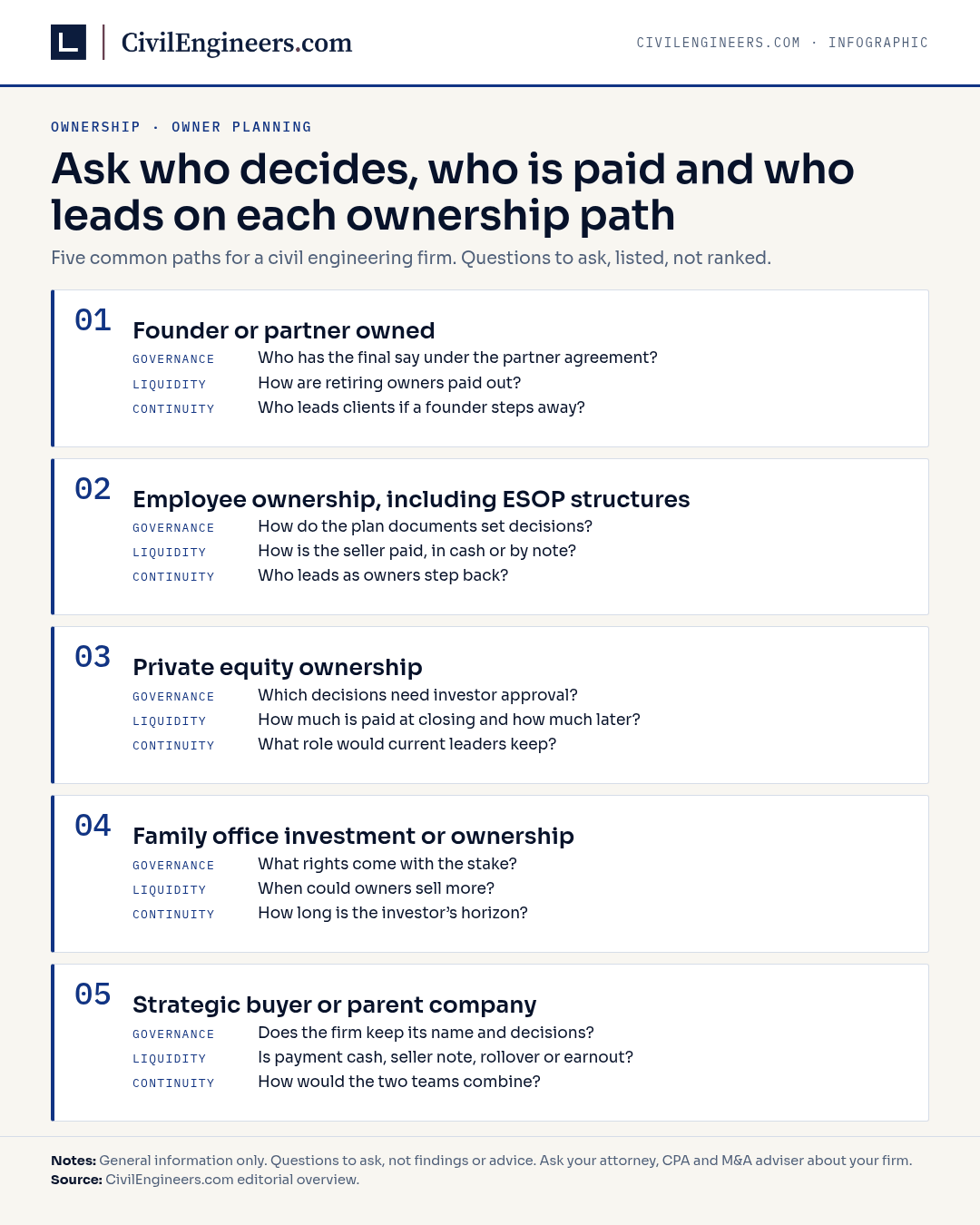
Ownership · Owner planning. Ask who decides, who is paid and who leads on each ownership path. Five common paths for a civil engineering firm. Questions to ask, listed, not ranked.
1. Founder or partner owned. Governance: Who has the final say under the partner agreement? Liquidity: How are retiring owners paid out? Continuity: Who leads clients if a founder steps away?
2. Employee ownership, including ESOP structures. Governance: How do the plan documents set decisions? Liquidity: How is the seller paid, in cash or by note? Continuity: Who leads as owners step back?
3. Private equity ownership. Governance: Which decisions need investor approval? Liquidity: How much is paid at closing and how much later? Continuity: What role would current leaders keep?
4. Family office investment or ownership. Governance: What rights come with the stake? Liquidity: When could owners sell more? Continuity: How long is the investor’s horizon?
5. Strategic buyer or parent company. Governance: Does the firm keep its name and decisions? Liquidity: Is payment cash, seller note, rollover or earnout? Continuity: How would the two teams combine?
These are questions to ask your attorney, CPA and M&A adviser. They are not findings, sourced facts or advice.
| Path | Governance | Liquidity | Continuity |
|---|---|---|---|
| 1. Founder or partner owned | Who has the final say under the partner agreement? | How are retiring owners paid out? | Who leads clients if a founder steps away? |
| 2. Employee ownership, including ESOP structures | How do the plan documents set decisions? | How is the seller paid, in cash or by note? | Who leads as owners step back? |
| 3. Private equity ownership | Which decisions need investor approval? | How much is paid at closing and how much later? | What role would current leaders keep? |
| 4. Family office investment or ownership | What rights come with the stake? | When could owners sell more? | How long is the investor’s horizon? |
| 5. Strategic buyer or parent company | Does the firm keep its name and decisions? | Is payment cash, seller note, rollover or earnout? | How would the two teams combine? |
Founder continuity: ask about an unexpected handoff
A firm president described assuming leadership after an unexpected founder absence. He also described caring for employees as part of carrying the founder's legacy forward.
Use that account to open a discussion with your leadership team and business attorney: Who would assume leadership if the founder became unavailable? What authority would that person need? How would employees receive direction and support? Counsel can review the proposed responsibilities against the firm's governing documents.
Compare how the owner gets paid
An M&A adviser distinguishes cash at closing, seller notes, rollover equity and earnouts. The adviser explains that a seller note exposes the seller to the buyer's ability to pay. The same source cautions that earnout accounting can complicate integration by keeping acquired operations separate for performance measurement.
For a discussion with your M&A adviser, transaction attorney and CPA, ask: How much is payable at closing? What supports repayment of a seller note? What equity would remain invested? How would an earnout be measured if the firms combine operations? Request a comparison of payment timing and conditions alongside the stated offer value.
Sources and further reading
- AEC Mergers and Acquisitions Transaction Success Factors (2025)
- 510: Building a Compelling Future: ESOPs, Acquisitions & Strategies for Entering New Sectors with James LaPosta of JCJ Architecture (2024)
- How a Civil Engineering Firm Can Maximize Employee Engagement: Ep 160 (2020)
- The American Dream: Building a Civil Engineering Firm: Ep 198 (2022)

